
Expert Clinical Counselling in North Vancouver | Avida
The Silent Cycle of Stress, Burnout, and Depression
17
Nov
The Silent Cycle of Stress, Burnout, and Depression
When Exhaustion Becomes Your New Normal
Have you ever felt so tired that even the things you used to enjoy feel like too much effort? In fast-paced communities like North Vancouver, high achievement is often celebrated. Whether you are a dedicated professional, a parent, or an expat navigating BC's high cost of living, you may find yourself constantly giving your energy to others.
Stress and burnout don't always arrive with obvious warning signs. They develop gradually. You may love your job and care deeply about your family, but constantly pushing your limits without enough recovery time slowly leads to emotional and physical exhaustion.
You begin cancelling plans, avoiding friends, or losing interest in activities that once brought you joy. You tell yourself, "I deserve to stay in bed all weekend. I've worked so hard, and the people around me should understand."
While you absolutely deserve to rest, there is a distinct difference between resting to recharge and withdrawing from life because you're emotionally depleted. Spending a weekend doing nothing may provide temporary relief, but it doesn't always restore your emotional energy. Gradually, you become less emotionally available to the people you love and miss meaningful moments. Not because you don't care, but because your nervous system has very little left to give.
Clinical Insight: Burnout vs. Depression
While their symptoms frequently overlap, burnout and depression are different clinical experiences. Burnout is typically situational—often tied directly to chronic workplace stress, endless caregiving, or specific overwhelming environments. If you remove the stressor, the burnout usually begins to lift. Depression, however, is more pervasive; it is a global lowering of mood that affects your self-worth and colours every aspect of your life, regardless of your environment. Understanding which one you are experiencing is the first step toward true healing.
Understanding the Cycle
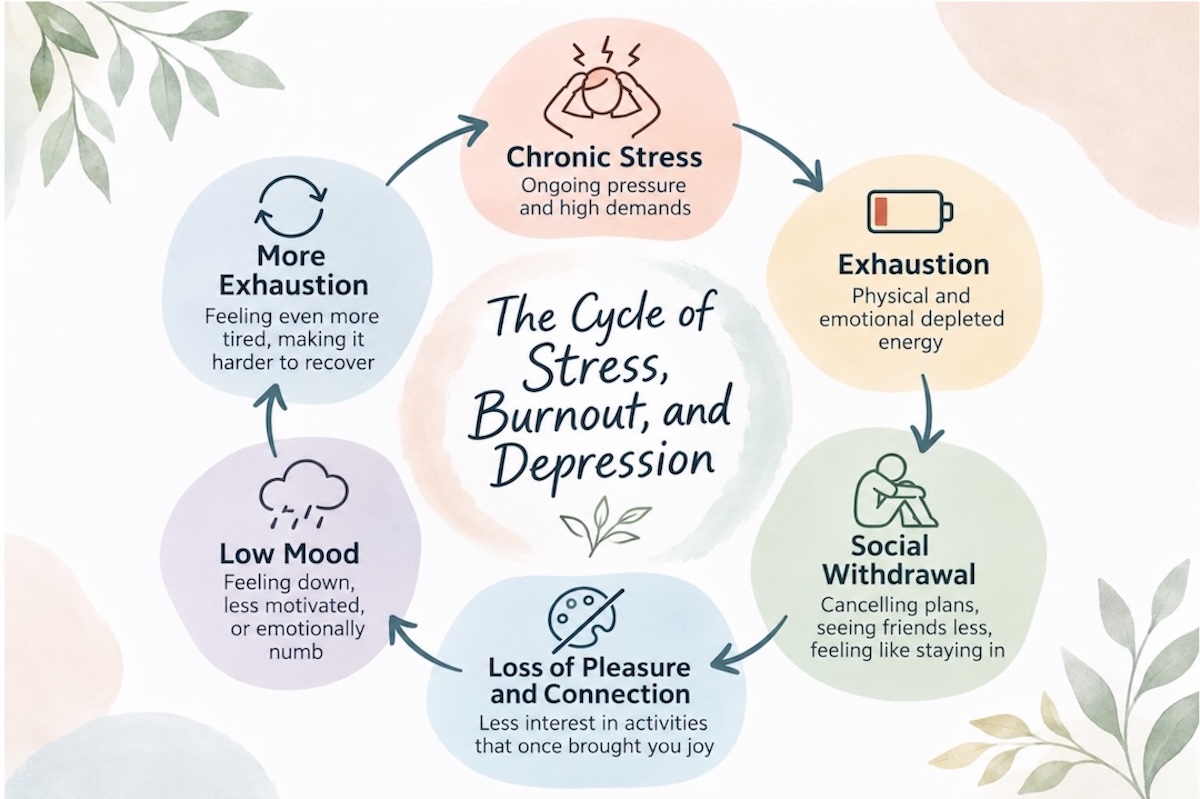
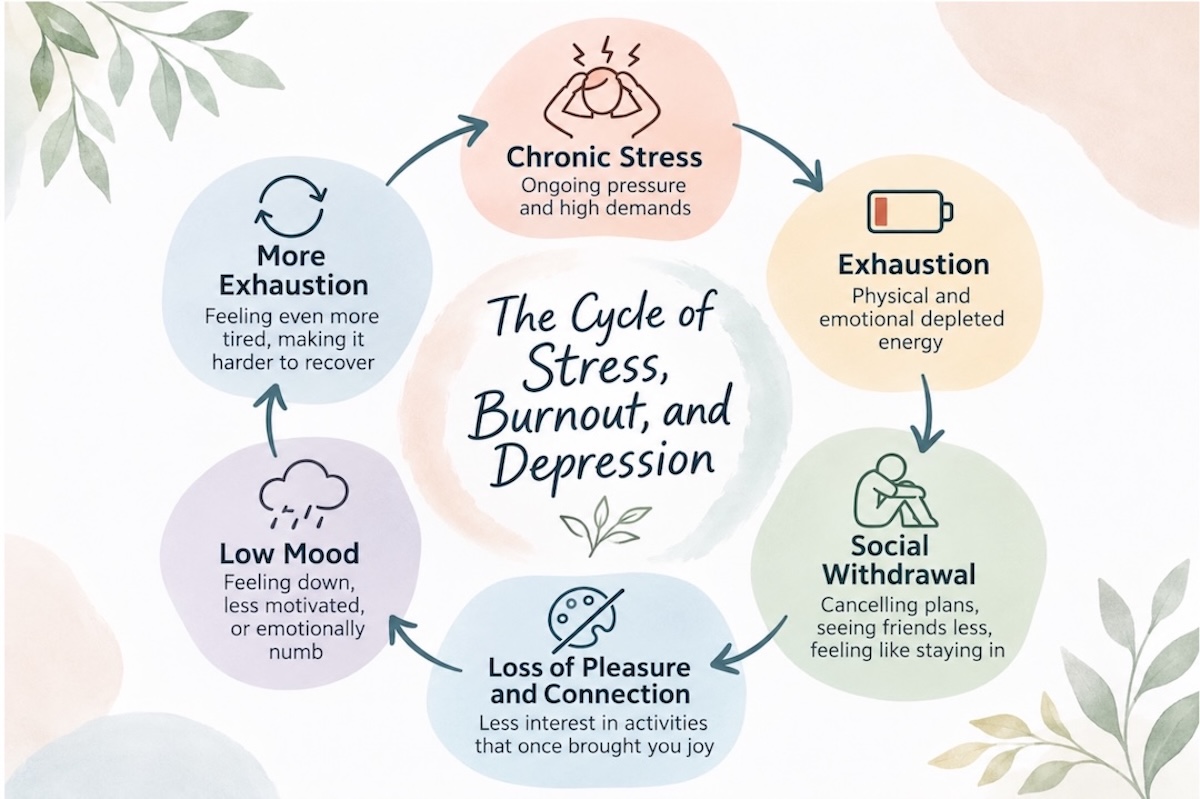
When left unaddressed, chronic stress creates a self-perpetuating loop. Here is exactly how that cycle unfolds, step by step:
· 1. Chronic Stress: It starts with ongoing pressure and high demands that outpace your ability to cope.
· 2. Exhaustion: Your physical and emotional energy becomes completely depleted.
· 3. Social Withdrawal: To conserve energy, you start cancelling plans, seeing friends less, and feeling the urge to just 'stay in.'
· 4. Loss of Pleasure and Connection: You lose interest in the hobbies, passions, and relationships that once brought you joy.
· 5. Low Mood: You begin feeling down, persistently unmotivated, or emotionally numb.
· 6. More Exhaustion: The low mood and lack of joyful connection make you feel even more tired, making recovery feel impossible and restarting the loop.
Small Steps Can Make a Difference
Recovery doesn't always require dramatic life changes. Sometimes, it begins with small, intentional actions to regulate your nervous system:
· Take microbreaks: Step away for just a few minutes throughout your high-stress day.
· Reconnect with your body: Try gentle stretching, mindful breathing, or a short walk in nature.
· Protect meaningful connections: Even a short 10-minute coffee with someone you feel safe with can shift your mood.
· Make room for pleasure: Don't wait until you feel motivated. Start with something small.
· Listen to your limits: Rest is a biological necessity, not a reward you have to earn through overwork.
Break the Cycle with Avida Counselling
You don't have to wait until you're completely exhausted to start taking care of yourself. At Avida Counselling, we specialize in helping high-achievers break free from the perfectionism trap and chronic stress.
Take the first step today. We offer a safe, non-judgmental space with culturally responsive therapy in English, Farsi, and Spanish. Book your complimentary 20-minute consultation to see how our Registered Clinical Counsellors (RCC) can support your journey back to balance.
By Luz Tremari, MACPAT, RCC
Share With